

Industrial Evaporators: A Guide to Thermal Design, Equipment Selection, and Process Optimization
Industrial evaporation is far more complex than a simple phase-change operation; it serves as the backbone of efficient chemical processing, resource recovery, and environmental compliance. The selection of evaporation technology is a critical engineering decision that permanently dictates a facility’s operating costs, product quality, and ability to meet stringent Zero Liquid Discharge (ZLD) mandates. Successfully designing these systems requires integrating thermodynamics, fluid dynamics, and specific process chemistry. By approaching evaporator selection through the lens of thermal optimization, energy recovery, and scaling mitigation, processing facilities can transform this equipment into an efficient, reliable processes.
The Critical Role of Evaporation in Modern Chemical Processing
Moving Beyond Simple Concentration
Modern chemical processing requires precision. Evaporation is utilized to increase the concentration of solutions, reduce the volume of effluents, or prepare streams for downstream crystallization. It is not merely about removing water; it is about protecting the integrity of the process stream.
The Economic and Environmental Drivers of Evaporator Selection
The modern regulatory environment demands aggressive waste management. Implementing advanced evaporation systems is essential for achieving Zero Liquid Discharge (ZLD) goals. By reducing the volume of liquid waste such as complex industrial effluents, companies significantly lower disposal costs. The economic driver is clear: high-efficiency systems reduce the utility footprint, directly impacting the bottom line through lower steam and electricity consumption.
Core Engineering Principles: Understanding the Physics of Evaporation
Heat Transfer Mechanisms and Turbulence Optimization
At the heart of every efficient evaporator is the heat exchanger. The rate of heat transfer is primarily governed by the temperature difference between the heating medium and the process fluid, as well as the heat transfer coefficient and heat transfer area. Maximizing heat transfer rates requires proactive engineering. Inducing turbulent flow is essential, as it increases heat transfer coefficient, which directly correlates to improved heat transfer efficiency. At the same time, this turbulent flow reduces fouling on tube walls, increasing time between boil outs.
The Impact of Operating Temperature on Product Quality and Degradation
When concentrating heat-sensitive fluids, the actual operating temperature is the critical factor in preventing product degradation. Exposing delicate compounds to high heat can lead to degradation of the compound. To safeguard product integrity, evaporation processes are engineered to run under vacuum conditions. Lowering the system pressure lowers the boiling point, allowing evaporation to occur at a mild temperature that shields the product from thermal damage.
Managing Solutions with High Boiling Point Elevation (BPE)
As a solution becomes more concentrated, the temperature required to boil it rises. This is called Boiling Point Elevation (BPE). If BPE is not accurately factored into the thermal design, the system will lose the temperature difference required to drive heat transfer, causing evaporation rates to drop. Successfully processing high concentration solutions requires careful consideration during the design phase to ensure sufficient heat transfer can be achieved. Precise pressure regulation and control then allow for the operational flexibility needed to counteract unexpected BPE rises and maintain consistent evaporation.
Primary Evaporator Technologies: A Comparative Analysis
Falling Film Evaporators: Efficiency for Low-Viscosity Applications
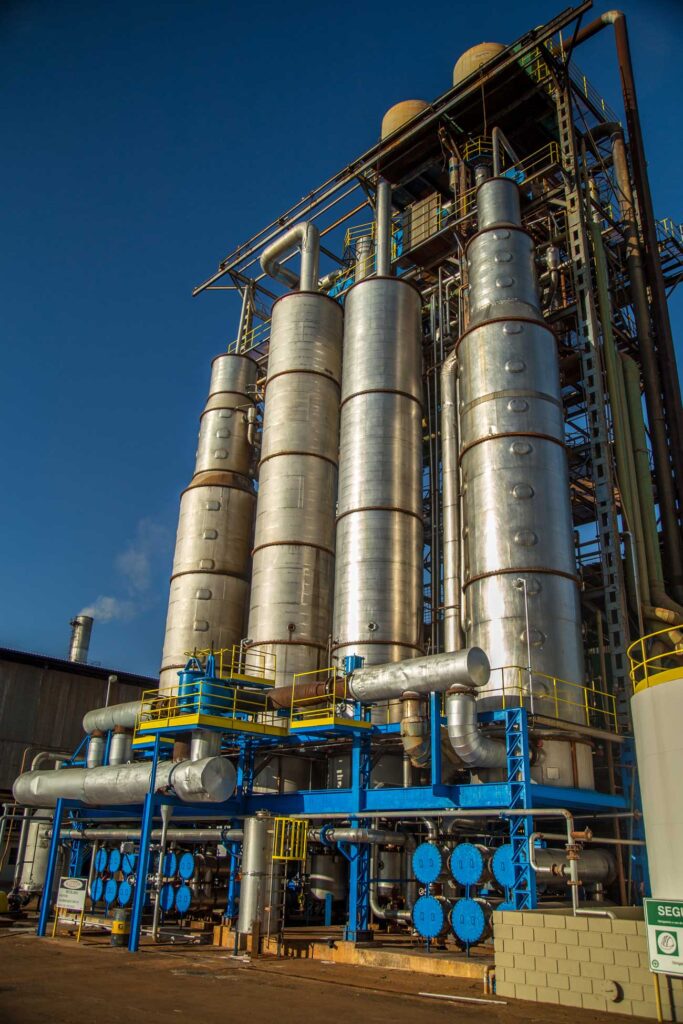
Falling film evaporators are used to concentrate liquids that do not have solids present. Falling film evaporators operate by introducing liquor to the top tube sheet, allowing for even distribution of liquor between the tubes. Driven by gravity, the liquor flows downward through the tubes creating a thin film along the tube walls. The thin film achieves a high heat transfer coefficient without relying on pumping.
- Ideal Application: Low-viscosity, heat sensitive fluids.
- Key Advantage: High heat transfer coefficients and reduced energy consumption
- Primary Maintenance Challenge: Ensuring no crystallization or scaling occurs
Forced Circulation Evaporators: The Solution for Scaling and Viscous Solutions
Forced circulation evaporator systems are a dependable solution for many of the most difficult process liquids that are prone to scaling and fouling. Forced circulation evaporators operate by utilizing a high capacity pump to circulate liquor through the heat exchanger. Driven by mechanical force, the liquor flows through the tubes at high velocities. This extreme turbulence achieves a high heat transfer coefficient while actively scrubbing the tube walls to increase time between boil outs.
- Ideal Application: Solutions high scaling potential or potential to crystallize.
- Key Advantage: High turbulence reduces scaling and handles high viscosity streams effectively.
- Primary Maintenance Challenge: Increased electricity consumption due to large pumping requirements.
Energy Efficiency Strategies: MVR vs. Multi-Effect Evaporation
Multi-Effect Evaporation: Leveraging Thermal Synergies
Multi-effect evaporator systems use the vapor produced in the first effect as the heating medium for the next. This significantly reduces steam consumption. By cascading the vacuum, these systems maximize steam economy where live steam is readily available.
Mechanical Vapor Recompression (MVR): Maximizing Resource Recovery
MVR evaporator technology operates by mechanically compressing the evaporated vapor. This compression raises the vapor’s pressure and corresponding saturation temperature, allowing it to be recycled as the heating medium for the same effect. By representing the peak of thermal optimization, MVR converts latent heat, which would otherwise be wasted, into a highly efficient electrical gain. This makes MVR the ideal choice for facilities with limited boiler capacity, strict carbon-reduction goals, or access to low-cost electricity.
Specialized Components: Enhancing Performance and Separations
Utilizing Demisters to Prevent Carryover and Contamination
Demisters are integrated to separate entrained liquor from the vapor stream. By routing the vapor to pass through a demister, these components remove liquor droplets preventing them from carrying over into the next step of the process such as into the vacuum or compression system, where scaling and maintenance issues could occur.
Circulation Pumps and Mechanical Reliability in High-Fouling Environments
In , the circulation pump is one of the most stressed components. Selecting materials resistant to erosion and corrosion is vital when processing abrasive or corrosive slurries. Proper sealing and consistent monitoring are the best ways to ensure operational uptime.
Industry-Specific Applications and Case Studies
Industrial Effluent Treatment: Zero Liquid Discharge (ZLD)
Evaporation is a critical process in industrial effluent treatment, driving both waste volume reduction and environmental abatement. By processing industrial effluent, plants can recover clean water for reuse within the facility while concentrating unwanted byproducts into concentrated slurry or solid stream. This proactive approach minimizes disposal costs and eliminates liquid waste liabilities, allowing facilities to successfully satisfy environmental discharge regulations.
Overcoming Operational Challenges: Scaling and Maintenance
Identifying the Roots of Scaling in Chemical Methods
Scaling is the result of unwanted crystal growth on the heat transfer surface. Recognizing the specific type of scale, such as calcium carbonate or calcium sulphate, is crucial for optimizing the system’s thermal design and establishing the correct operational parameters. Continuously monitoring the heat transfer coefficient across the heat exchanger provides operators with the necessary data needed to optimize boil out cycles and maintain efficient operation.
Chemical Precipitation and Pre-treatment Strategies
Pre-treatment is the proactive way to mitigate scaling. Pre-treating the feed removes or reduces scaling compounds before they enter the evaporator system. This step can extend the time between boil outs, in turn, increasing operational uptime.
Evaporator Boil Out Procedures and Maintenance Protocols
When scaling begins to impact heat transfer, completing a boil out is the primary method of removing scale and crystal build up. A boil out utilizes water, sometimes heated depending on the application, to dissolve scale from the heat transfer surfaces. Depending on the process conditions and severity of the scale and build up, operators can perform a partial boil out, which reduces and dilutes the existing content in the evaporator body with water, or a full boil out, which involves completely emptying the evaporator and refilling the system with water. Adhering to a regular boil out schedule restores the efficient heat transfer.
Conclusion: Engineering for Resilient Thermal Processing
Designing an industrial evaporation system requires integration of thermodynamics, fluid dynamics, and specific process chemistry. From managing boiling point elevation (BPE) and mitigating scale through proactive pre-treatment, to selecting the appropriate evaporation technologies, such as falling film or forced circulation, every engineering decision permanently impacts a facility’s operational efficiency.
As plants strive to meet Zero Liquid Discharge (ZLD) mandates and environmental regulations, balancing capital investment with operating costs becomes critical. Integrating energy recovery technologies, whether through the cascading thermal reuse of multiple effect configurations or the electrical efficiency of Mechanical Vapor Recompression (MVR), ensures these compliance goals are met without compromising the bottom line.
Maximizing plant uptime relies on optimized thermal designs with rigorous monitoring and proactive maintenance protocols. Navigating these compounding complexities requires thermal engineering and operating expertise. Engaging with the experts at Whiting Equipment Canada ensures that evaporation systems are precisely engineered for the application. Contact Whiting Equipment Canada’s technical team today to assess current system efficiencies, optimize maintenance cycles, or consult on the design of a high-performance evaporation solution.