

The Engineering Logic Behind Industrial Evaporation
Industrial evaporation is a thermal separation process: apply heat to a solution, drive off volatile solvent as vapor, and leave behind a concentrated product stream, or recover the solvent itself for reuse. The principle appears simple. Executing it at 50,000 pounds of water removed per hour, against a fouling liquor, in a continuous 24/7 duty cycle, is complex.
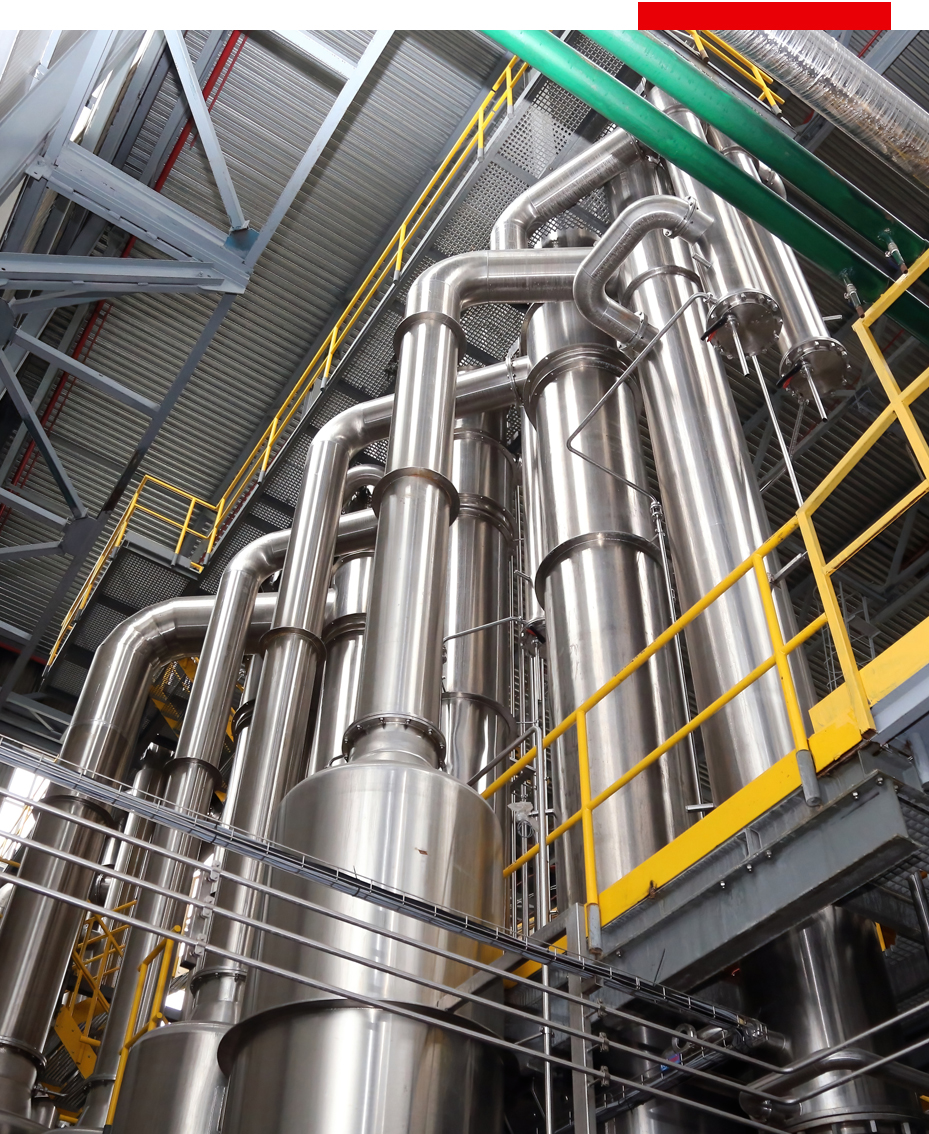
That scale is the first thing to settle. An industrial evaporator is a multi-story pressure vessel with hundreds of tubes, an integrated condenser train, vacuum equipment, and a liquor circulation loop.
Market trends reflect the complexity of industrial evaporators. Heat transfer efficiency drives every selection decision. Steam economy for a triple-effect evaporator typically ranges between 2 and 3, and that ratio (pounds of water evaporated per pound of steam consumed) is where capital cost meets operating reality.
Falling Film vs. Forced Circulation: Matching Design to Fluid Dynamics
The falling film vs forced circulation evaporator question resolves almost entirely on fluid behavior at the tube wall.
In a vertical falling film evaporator, feed is distributed at the top of a tube bundle and descends as a thin annular film under gravity. Residence time is short, the temperature difference required is small, and the liquid never sits in a hot pool. That makes it the default for heat-sensitive products. The weakness is distribution: if any tube runs dry, the wall scorches and fouls immediately. Viscous or solids-laden feeds compromise the film before they compromise anything else.
Forced circulation inverts the logic. A high-capacity axial pump drives liquor through the tubes at velocities sufficient to suppress boiling inside the bundle entirely. Flashing occurs in the separator instead. Nothing nucleates on the tube wall, which is why forced circulation is the standard for crystallization duty and for liquors that scale aggressively.
A long tube vertical type evaporator sits between them, using thermosiphon-driven natural circulation where the fluid permits it and forgoing pump energy as a result.
| Design Type | Ideal Fluid | Primary Benefit |
| Falling film | Low-viscosity, heat-sensitive | Low ΔT, short residence time |
| Forced circulation | Scaling, viscous, crystallizing | Suppressed tube-side boiling |
| Long tube vertical | Clean, moderate-viscosity | No circulation pump load |
Mechanical Vapor Recompression (MVR) and Steam Economy
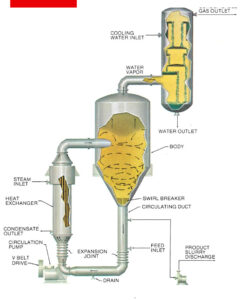
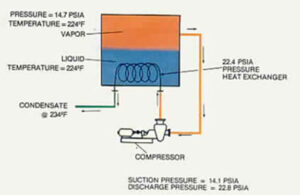
Steam economy is the governing metric: pounds of water evaporated per pound of live steam supplied. In a multi-effect arrangement, vapor from the first effect becomes the heating medium for the second, which heats the third, with each effect operating at progressively lower pressure. Steam economy for a triple-effect evaporator typically ranges between 2 and 3 which is the point where additional effects no longer justify their cost.
MVR evaporators operate on a different principle. Rather than cascading vapor downward through pressure stages, a mechanical compressor raises the vapor’s saturation temperature and returns it to the same calandria that produced it. The latent heat is recycled within a single effect, and the plant’s need for external steam is reduced to startup and minor adjustments.
Selection factors worth weighing:
- MVR versus TVR — thermal vapour recompressors are cheap and have no moving parts, but they need motive steam and only handle a fraction of the vapor flow. Mechanical compression handles the full stream on electrical input.
- Utilization hours — MVR’s capital premium amortizes on continuous operation, not intermittent campaigns.
- Energy pricing — the trade is steam cost against electricity cost, and that ratio defines the payback.
- Boiling point rise — high BPR liquors erode the available temperature lift and push designs back toward multi-effect.
Critical Components: The Role of Condensers and Vacuum Systems
An evaporator only evaporates as fast as its condenser can remove vapor. Condensing collapses the vapor phase and establishes the suction that sustains vacuum; if condenser duty falls short, back pressure rises, the available temperature difference shrinks, and throughput drops regardless of how much steam is available at the calandria.
Four condenser types dominate industrial service:
- Surface (shell and tube) — vapor condenses on the outside of a cooling-water bundle, keeping process condensate physically separated from cooling water, which is essential for solvent recovery and for any stream that can’t be discharged.
- Plate — gasketed or welded plate packs deliver high heat transfer coefficients in a compact footprint, suited to clean duties with moderate pressure demands.
- Barometric — direct-contact condensing where cooling water sprays into the vapor stream, inexpensive and fouling-tolerant, but it mixes the two streams and generates a large effluent volume.
- Evaporative — combines a tube bundle with a water spray and induced airflow, cutting cooling water consumption where make-up water is constrained or costly.
Maintaining vacuum levels is crucial. Lowering absolute pressure lowers the boiling point, which protects thermally fragile products and widens the usable ΔT without raising steam temperature. Non-condensable gas removal (vacuum pumps or steam ejectors) keeps that vacuum stable.
Industry-Specific Applications: Pulp, Food, and Chemical Processing
Pulp & Paper
Black liquor concentration is one of the most challenging evaporation duties in the industry. Solids content climbs from roughly the weak liquor range to fired concentrations, viscosity rises sharply, and scaling compounds precipitate as the liquor concentrates. Multi-effect trains handle the early stages, with forced circulation units placed at the high-solids end where boiling point rise and deposition would destroy a film-based design.
Food & Beverage
Juice concentrates, dairy streams, and protein solutions degrade on contact with hot surfaces. Falling film designs under deep vacuum dominate here because short residence time and low temperature difference preserve colour, flavour, and nutritional integrity. Sanitary construction, full drainability, and clean-in-place compatibility are design constraints, not accessories.
Chemical
Chemical processing combines aggressive media with elevated pressure. Solvent recovery, salt concentration, and waste minimization all demand materials matched to the specific corrosion mechanism — duplex and super-duplex stainless, nickel alloys, titanium, or clad construction where chloride or acid attack would consume standard grades. Among industrial evaporator types, this sector most often requires custom-engineered alloy selection and vessel design rather than catalog equipment.
Key Takeaways for Evaporator Selection
The decision reduces to a handful of technical commitments made before any vendor conversation begins.
- Falling film evaporators suit heat-sensitive, low-viscosity fluids. Short residence time and small temperature differences protect product quality, provided feed distribution keeps every tube wetted.
- Forced circulation is mandatory for scaling or crystallizing fluids. Pump-driven velocity suppresses boiling inside the tubes, moving vapor release into the separator and keeping deposition off the heat transfer surface.
- MVR delivers the strongest energy position for high-utilization plants. Recompressing vapor back into the same heating element recycles latent heat and shifts the operating cost from steam to electricity which is worth evaluating against local energy pricing.
- Multi-effect steam economy improves with each effect but not without limit. Added effects raise capital cost and consume available temperature difference, which is why three effects is a common practical stopping point.
- Shell and tube construction remains the heavy-duty standard. For high-pressure, abrasive, or corrosive service, the design’s mechanical margin and material flexibility continue to outweigh the compactness of alternatives in industrial evaporation systems 2026 and beyond.
Engineering for Extremes: The Whiting Advantage
Standard equipment solves standard problems. The duties that justify a capital project rarely qualify where extreme capacity, aggressive chemistry, elevated pressure, or a combination no catalog unit was built to survive.
Whiting Equipment Canada builds big things for applications that fall outside conventional specification. Custom evaporators and crystallizers are engineered around the actual process fluid: its viscosity curve, its fouling tendency, its boiling point rise, its corrosion behavior against candidate alloys. That work begins collaboratively, with Whiting’s engineering team working through process data, thermal duty, and mechanical constraints alongside the plant’s own engineers before a single drawing is issued.
The payoff is measured over years of continuous service rather than at commissioning. Heavy-wall construction, appropriate metallurgy, and heat transfer surfaces sized for real operating conditions determine whether a unit holds its design rate through a decade of harsh duty or becomes an annual maintenance liability.
If your concentration, solvent recovery, or crystallization requirement doesn’t fit a standard envelope, consult with Whiting. One-of-a-kind handling and processing challenges are their specialty.