



What Is Materials Handling? A Complete Guide to Systems, Equipment, and Industrial Applications
Introduction: Moving Beyond the Forklift
When most people envision material handling, they see a single image: a forklift navigating a warehouse aisle. While the industrial truck is a staple of the sector, limiting the definition to machinery ignores the complex, sustainable circulatory system of the global supply chain. Materials handling is the integrated art and science of moving, protecting, storing, and controlling products throughout their lifecycle—from the moment raw components enter a manufacturing plant to the final delivery of finished goods.
With a market projected to exceed $319 billion by 2029, the industry is shifting from brute-force mechanical power toward cognitive, data-driven orchestration. This evolution is not merely about replacing human labour with robots; it is about creating a harmonious ecosystem where technology amplifies human capacity. By mastering the movement of goods, businesses unlock hidden profitability, optimize facility throughput, and secure a competitive advantage in an increasingly volatile global market.
The Strategic Role of Materials Handling in the Modern Supply Chain
Materials handling serves as the connective tissue of the modern supply chain. Every touchpoint, from the loading docks where shipments arrive to the shelving units that house inventory, impacts the velocity of business operations. In an era where “just-in-time” is often replaced by “just-in-case” inventory strategies, the agility of a materials handling system determines a company’s ability to respond to demand surges. By reducing dwell time and minimizing unnecessary movement, organizations reduce their operating costs and shrink their carbon footprint, transforming the warehouse, assembly and MRO facility from a cost center into a strategic asset.
Defining Materials Handling: Movement, Protection, Storage, and Control
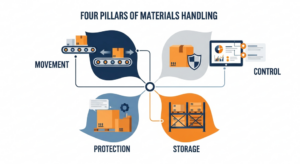
The four interconnected pillars of materials handling work together to ensure operational excellence and efficiency in the supply chain.
At its core, materials handling involves four distinct but interconnected functions. Movement focuses on the efficient transfer of units between locations. Protection ensures that goods remain untarnished and functional, preventing damage during transit. Storage encompasses the spatial management of inventory, ensuring that every square foot is utilized effectively. Finally, Control provides the visibility—the “information layer”—that tracks where items are, where they are going, and when they are needed. Together, these pillars define the operational excellence required to succeed in high-volume industrial environments.
The Four Pillars of an Effective Materials Handling System
Movement: Efficient Flow from Receiving to Shipping
The movement of goods is the primary metric of assembly, manufacturing, MRO, and warehouse productivity. Whether utilizing automated guided vehicles or human-operated carts, the goal is to reduce travel time. Efficient flow requires a layout that minimizes backtracking and congestion. Strategic placement of goods—placing fast-moving SKUs near the shipping area, for instance—significantly reduces travel distance for operators and automated vehicles alike.
Storage: Optimizing Square Footage and Cube Space
Storage is often misunderstood as simply “holding stuff.” In professional logistics, it is a game of three-dimensional geometry. Companies must balance horizontal floor space—which can lead to wider, less efficient aisles—with vertical “air rights.” By utilizing tall racking systems and mezzanines, firms maximize cube utilization, allowing for higher inventory density without increasing the physical footprint of the building. Here, AGVs with specialized tooling like scissor lifts for picking can offer efficiency and safety to the facility.
Protection: Safeguarding Goods from Damage and Spoilage
Goods in transit are vulnerable. Protection involves selecting the right containers, palletizing strategies, and environmental controls. From fragile electronics requiring shock-absorbent packaging to temperature-sensitive pharmaceutical goods, the strategy must align with the material’s specific needs. Proper containment prevents inventory shrinkage and reduces the costs associated with damaged returns. AGVs with their sensors and other safety systems can protect both product and people while in transit.
Control: Using Data and Inventory Control for Real-Time Visibility
Control is the nervous system of modern materials handling. Real-time visibility is achieved through Warehouse Management Systems (WMS) and automated tracking technologies. When a system knows the exact location and quantity of every bag, carton, or container, it minimizes search time and prevents stockouts. Data-driven control turns potentially chaotic, unorganized movement into a highly predictable, repeatable process.
The Materials Handling Maturity Model: From Manual to Autonomous
Level 1: Manual Materials Handling (MMH) and Basic Tools
Manual handling is the foundation of the industry. Despite the rise of robotics, human workers remain the most flexible components of an assembly, manufacturing, MRO or warehouse facility. Success at this level depends on proper training, the use of basic tools like dollies, MGVs and a deep commitment to ergonomics to prevent injury.
Level 2: Mechanized Handling (AGVs and Conveyors)
Mechanization introduced the era of high-throughput logistics. AGVs, conveyors, and pallet jacks allowed for the movement of heavy loads at speeds impossible for humans. This level remains the standard for most small-to-mid-sized facilities, focusing on automated, hardware-centric solutions to bridge distance and weight barriers.
Level 3: Automated Systems (AS/RS and VLMs)
Automation reduces human error and increases density. Automated Storage and Retrieval Systems (AS/RS) and Vertical Lift Modules (VLMs) move inventory to the operator, rather than forcing the operator to traverse aisles. This transition increases safety, as personnel remain in designated picking zones, and in their work cells away from moving equipment.
Level 4: Intelligent/Cognitive Systems (AI and Collaborative Robots)
The peak of maturity is the integration of AI and cobots. These systems don’t just follow pre-programmed paths; they analyze real-time demand, optimize routes on the fly, and work alongside human counterparts as well as AGV systems to streamline operations. This layer represents the future of the supply chain: responsive, adaptable, and highly efficient.
Essential Categories of Materials Handling Equipment
Storage and Handling Equipment (Pallet Racks, Shelving, and Mezzanines)
Static storage is the bedrock of facility organization. Racking systems determine the maximum load-bearing capacity and dictate the flow of traffic. Mezzanines allow businesses to grow vertically without expanding their property, effectively doubling floor space in high-ceiling environments. This is important at a busy manufacturing or assembly operation where parts are picked continuously and delivered to the floor via AGVs for build outs of the finished product.
Engineered Systems (Automated Storage and Retrieval Systems – AS/RS)
AS/RS represents a significant capital investment but offers massive returns in throughput and accuracy. By utilizing automated guided vehicles or even manually guided vehicles, these systems turn the assembly, manufacturing, MRO or warehouse into a computer-controlled data center, where every unit is accessible in seconds.
Modern Automation: AGVs and Cobots
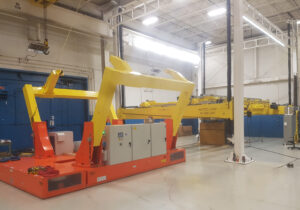
Automated Guided Vehicles (AGVs)
AGVs follow fixed paths (often magnetic tape or wires), or cameras to navigate around obstacles. AGVs provide superior flexibility to Forklifts, allowing them to adapt to changing floor layouts without the need for costly infrastructure modifications.
Collaborative Mobile Manipulators and the Rise of “Cobots”
Collaborative robots, or “cobots,” are designed to work safely alongside humans and AGV systems. Unlike industrial bots that require safety cages, cobots feature sensors that stop movement upon contact, making them ideal for assembly, packing, and repetitive sorting tasks.
The Engineering of Efficiency: Unit Loads and Material Flow
The Unit Load Concept: Maximizing Throughput Efficiency
The “unit load” is the basic building block of handling. By standardizing loads into pallets or specific containers, the entire supply chain becomes modular. Standardized units allow for faster loading, easier storage, and better inventory tracking, serving as the core of industrial efficiency.
Developing a Material Flow Diagram for Warehouse Optimization
A material flow diagram is an essential mapping tool. By visually tracking the path of a product from the loading dock to the shipping bay, managers can identify bottlenecks and crossing traffic patterns. Mapping these flows helps in designing “straight-line” workflows that minimize travel.
Addressing Bottlenecks in Production Lines and Loading Docks
Bottlenecks are the silent killers of ROI. Whether it is a congested loading dock, during assembly in work cells, or a slow packing station, these delays cascade through the supply chain. By applying Lean methodologies and increasing the responsiveness of the handling equipment, managers can clear these jams and ensure consistent output.
Safety and Ergonomics: The Human-Centric Side of Material Handling
Identifying Ergonomic Hazards and Musculoskeletal Disorders (MSDs)
Hazard prevention is the ethical and financial responsibility of every industrial leader. Ergonomic hazards arise from repetitive lifting, poor posture, and excessive vibration. Left unaddressed, these issues lead to MSDs, which represent a significant portion of workplace injuries and long-term disability claims.
Applying the NIOSH Lifting Equation to Manual Tasks
The NIOSH Lifting Equation is the gold standard for assessing manual tasks. By considering weight, distance, and frequency, managers can mathematically determine if a lift poses an injury risk. Implementing this tool helps in redesigning manual workstations to ensure that the human worker remains safe, productive, and comfortable throughout their shift.
Conclusion
Materials handling is far more than a supporting function of industry; it is the vital, pulsing heart of the global economy. As we have explored, the journey toward an optimized system requires a holistic balance between mechanical power, spatial intelligence, and human-centric safety. By moving beyond traditional views and embracing the maturity model—transitioning from basic manual tools toward cognitive, autonomous systems—businesses can transform their operations into highly efficient machines.
The path to operational excellence requires constant vigilance over the four pillars: movement, storage, protection, and control. When implemented correctly, these elements act in concert to maximize cube utilization, reduce hazard exposure, and ensure a seamless flow of goods. As technological advancements continue to lower the barrier to entry for robotics and AI, the importance of maintaining a strategic, data-driven approach to materials handling has never been higher.
For leaders looking to enhance their logistics footprint, the next step is a rigorous audit of existing workflows. If you require specialized guidance on optimizing your facility’s layout, selecting the right handling equipment, or implementing ergonomic safety protocols, we encourage you to seek out professional industrial engineering consultation. Whiting’s partner, Handling Specialty is your fist choice for custom material handling solutions. Investing in the health and efficiency of your handling systems is not just an operational necessity—it is the cornerstone of sustainable growth in the modern supply chain. Contact us for more information.