


Recovering Mother Liquor for Yield & Sustainability
In every crystallization system, a portion of the desired product remains dissolved in the mother liquor — the liquid left behind after solids are separated. Recovering that stream is one of the most direct ways to boost yield, reduce waste, and cut energy and reagent costs.
For lithium refineries using brine or hard-rock feedstocks, mother liquor recovery crystallization is not only a technical exercise in mass balance but also a key element of plant sustainability. The same design principles that improve yield also support environmental goals, including reduced waste discharge, lower raw material consumption, and a higher return on investment (ROI).
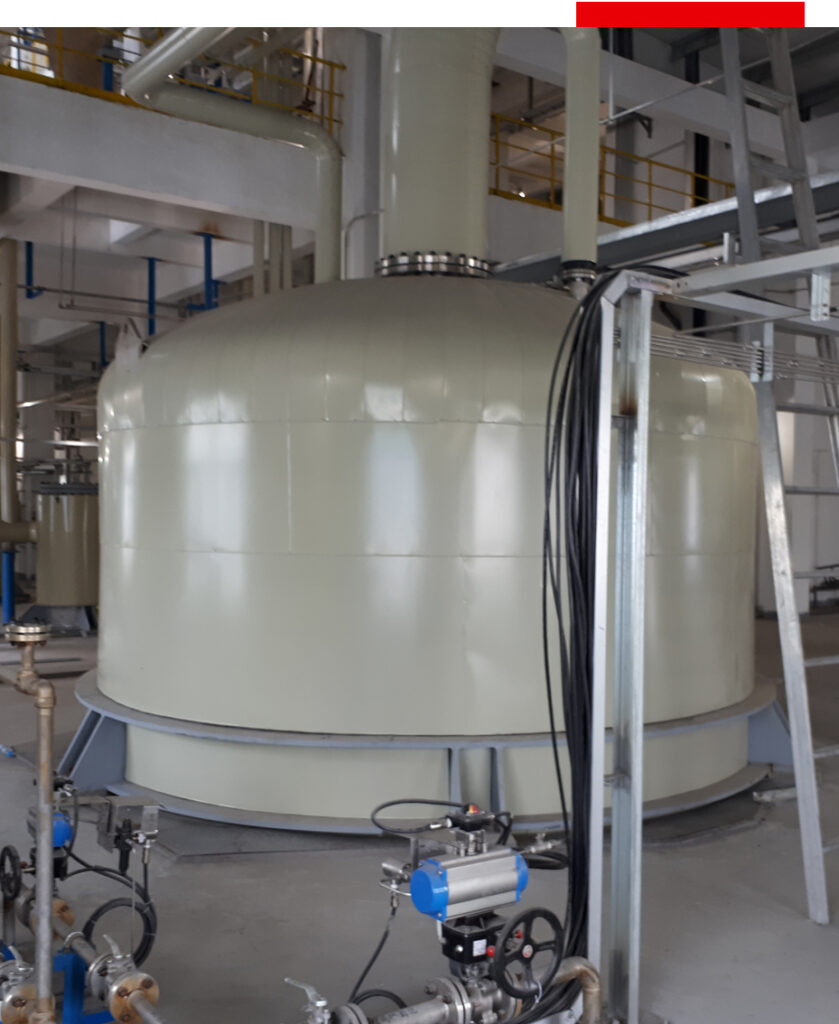
Whiting Equipment Canada Inc. and its licensee, Swenson Technology, supply evaporation and crystallization systems that make this kind of closed-loop recovery practical at an industrial scale.
Mass Balance and Recycle Loops
Efficient mother liquor recovery crystallization begins with a well-defined mass balance. Each stage of the crystallization train must account for the amount of lithium remaining in the liquid phase and the amount captured as solid.
During early bench testing, engineers collect yield and purity data to establish the lithium distribution coefficient—the ratio of lithium in crystals to that remaining in the mother liquor. This information defines the basis for recycling design.
In full-scale systems, recycle loops route part or all of the mother liquor back to earlier stages of the process. The simplest loop reintroduces clarified liquor to the evaporator feed, while more advanced designs employ multi-stage loops that adjust concentration, pH, or temperature before reuse.
Each loop must maintain lithium recovery efficiency without accumulating impurities that could affect crystal habit or purity. This balance is achieved through continuous modeling and real-time analysis of the liquor composition.
Impurity Management
Recycling mother liquor introduces a paradox: it raises yield but risks impurity buildup. Effective design isolates contaminants while keeping lithium in circulation.
Crystallizers act as the primary purification tool. By controlling supersaturation and growth rates, impurities are either excluded from the crystal lattice or remain in solution, where they can be purged deliberately.
In a typical lithium refining loop:
- Calcium, magnesium, and sulfate ions remain in the liquor phase and are periodically bled off to prevent concentration beyond solubility limits.
- Solids washing and centrifuge performance determine how much residual liquor clings to crystals, influencing both purity and the overall material balance.
- Monitoring dissolved impurities with conductivity or ICP (inductively coupled plasma) analysis ensures the liquor’s composition remains within target specifications.
By stabilizing impurity concentrations, the refinery maintains steady-state operation, maximizing lithium recovery without compromising product quality.
Energy Integration
Mother liquor recovery isn’t only about chemistry; it’s also about energy. Each recycled stream carries thermal value that can be reused in evaporation or crystallization.
Integrating this liquor into the plant’s heat recovery network reduces steam demand and cooling water consumption. For example:
- The liquor exiting a crystallizer at elevated temperature can preheat fresh feed through a plate heat exchanger.
- In multi-effect evaporator systems, vapor from one effect can provide latent heat to another, reducing total energy input.
- When mechanical vapor recompression (MVR) is used, recovered liquor streams can stabilize temperature profiles and enhance compressor efficiency.
This coupling of material and energy balances embodies the core of sustainable refinery design—recovering not just lithium but also the energy used to process it.
Economics and ROI
Every percentage point of recovery directly improves profitability. The relationship between yield and ROI can be summarized simply:
- Higher lithium recovery → lower feedstock cost per ton of product.
- Reduced waste volume → lower disposal and environmental compliance costs.
- Improved energy efficiency → lower operating expenses (OPEX).
Pilot testing conducted by Swenson identifies washing efficiency, centrifuge recovery, and scaling tendencies, all of which feed into the economic model for commercial design. Over time, this model supports optimization — adjusting recycle ratios or purge rates to maintain profitability as feed composition changes.
Plants operating according to this time-tested strategy report measurable benefits, including longer campaign times, fewer wash cycles, and more consistent product quality — all of which translate to higher overall yield.
Worked Example (Conceptual)
Imagine a lithium carbonate crystallization line producing 20,000 tons per year. If 3% of lithium remains in the mother liquor and half of that can be economically recovered through a recycle loop, the net gain is roughly 300 tons per year—without any increase in raw feed.
At even modest lithium carbonate prices, that translates into millions of dollars in additional revenue, achieved primarily through design optimization and process control rather than capital expansion.
(This is a conceptual or illustrative scenario, not a verified case study. Actual recoveries depend on impurity buildup, purge requirements, and energy balance.)
QA Implications
Recycling introduces new quality assurance requirements. Each cycle must confirm that critical parameters—purity, morphology, and moisture content—remain within their respective tolerances.
Inline analyzers and laboratory sampling confirm that impurities aren’t re-entering the crystallization loop at levels that compromise purity. Periodic testing of wash efficiency and centrifuge separation data closes the feedback loop between QA and operations.
Because crystallization defines the final particle size and purity, QA integration ensures that recovery efforts do not undermine product performance in downstream battery applications.
Sustainability and Resource Stewardship
Beyond yield and profit, mother liquor recovery aligns directly with the sustainability mandates now shaping the global lithium supply chain. Every kilogram of lithium recovered reduces mining intensity and water consumption upstream.
The combination of efficient crystallization, controlled recycle, and optimized purge design allows lithium producers to:
- Lower overall brine extraction or ore throughput.
- Minimize liquid waste discharge.
- Demonstrate quantifiable improvements in resource efficiency — key metrics in ESG reporting frameworks.
This approach converts what was once a waste stream into a measurable sustainability asset, reinforcing both environmental and financial performance.
Conclusion
Recovering mother liquor is one of the most straightforward ways to improve both yield and sustainability in lithium refining. By uniting crystallization science, impurity management, and heat integration, refineries can achieve higher recovery while lowering waste and energy use.
Whiting Equipment Canada and Swenson Technology’s crystallization systems are built with this philosophy in mind — engineered for high recovery, operational stability, and measurable ESG impact.
Work with Whiting Equipment Canada to optimize your lithium recovery strategy. From pilot testing and mass-balance modeling to full-scale crystallization and recycle design, Whiting helps you close the loop — capturing more lithium, reducing waste, and maximizing the long-term ROI of your refining operation. Contact us to discuss your requirements.