

Mechanical Vapor Recompression (MVR) Guide
For process engineers and plant decision-makers evaluating energy recovery systems, mechanical vapor recompression (MVR) represents both an opportunity and a financial test. It’s one of the most thermally efficient evaporation methods available—yet also one of the most capital-intensive. The key question is not whether MVR works (it does), but when it pays off.
Whiting Equipment Canada Inc., through its licensee Swenson Technology, brings decades of experience in designing energy-optimized evaporation systems for the lithium, fertilizer, and chemical processing industries. Our approach—rooted in rigorous process modeling, pilot testing, and life-cycle cost analysis—provides the decision-making framework operators need to determine when an MVR investment “pencils out.”
Principle of Operation
MVR works by compressing and reusing the vapor generated during evaporation as a heat source. Instead of discarding low-pressure vapor, a mechanical compressor raises its pressure and temperature, allowing it to re-boil the feed solution.
This closed-loop heat recovery cycle drastically reduces the need for external steam. Typical single-effect evaporators require one kilogram of fresh steam for every kilogram of water removed. In contrast, MVR systems can achieve a steam-equivalent economy of 10–15:1, depending on the compressor efficiency and the process temperature lift.
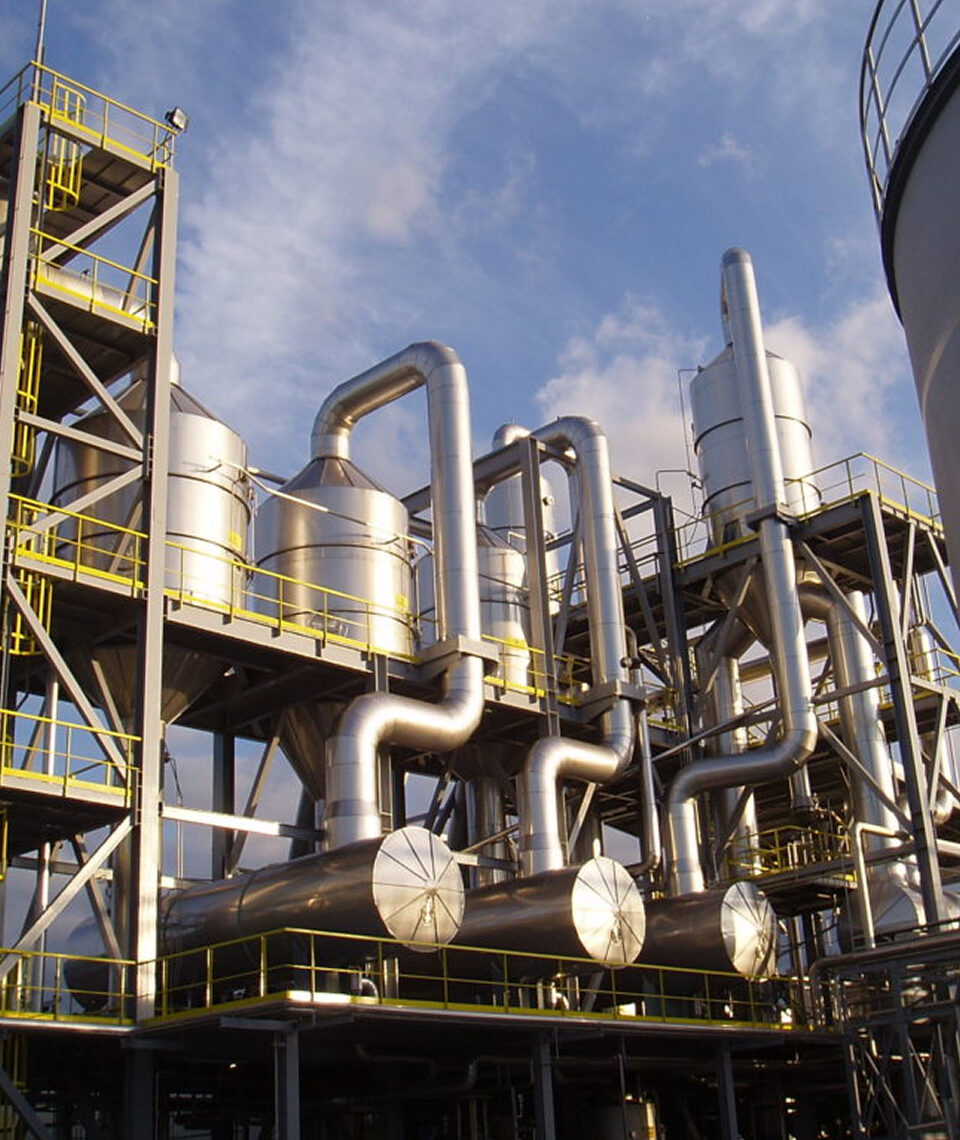
Whiting and Swenson’s evaporation systems—particularly falling-film and forced-circulation designs—are ideal MVR candidates, offering excellent heat transfer coefficients and robust hydraulic control, especially for high-salinity or scaling-prone solutions, such as lithium brines.
Energy Model & Utility Rates
The financial success of mechanical vapor recompression depends on a careful comparison between fuel, steam, and electrical power costs. MVR consumes electricity to drive its compressor but virtually eliminates direct steam demand.
In markets where electricity costs are low or where steam must be generated from fossil fuels, MVR becomes increasingly attractive. Conversely, in sites with abundant waste steam or integrated cogeneration, multi-effect evaporation may remain the more economical option.
Swenson’s engineering workflow begins with thermodynamic modeling of the process stream—calculating temperature differentials, latent heat loads, and the compression ratio required to sustain the vapor loop. These inputs form the backbone of any ROI model, allowing clients to quantify the breakeven point between operating savings and capital cost.
A rule of thumb: for every ton of steam displaced by MVR, approximately 25–30 kWh of power is required. Using process simulation, Whiting’s engineers align equipment design with local utility rates to identify the lowest-cost configuration for each project.

Feed Characteristics
MVR is most effective when handling clean or moderately scaling feeds with steady throughput. High-fouling solutions can reduce compressor efficiency, increase maintenance cycles, and shorten equipment life.
To mitigate these risks, Swenson conducts pilot testing to evaluate scaling and fouling tendencies under controlled conditions. Data from these tests inform the choice between falling-film and forced-circulation systems—and whether to include pre-treatment or hybrid stages (such as a small multi-effect front-end) to stabilize feed quality before the vapor compression loop.
For lithium and chemical producers, this design rigor is especially crucial: brine chemistry, impurity loading, and solids content can vary significantly, affecting compressor performance and the long-term economics of the installation.
Maintenance Profile
While MVR systems offer superior efficiency, they introduce moving mechanical components—most notably the compressor—which require disciplined maintenance. Bearings, seals, and impellers must operate under precise conditions to prevent vibration and wear.
Swenson’s and Whiting’s design philosophy addresses reliability from the start. All of our equipment is engineered for long-term performance in harsh environments, with materials and layouts tailored to customer-specific operating conditions. Pilot testing identifies fouling behaviors and helps define cleaning intervals, while predictive maintenance programs based on vibration and power-draw monitoring can further reduce unplanned downtime.
When properly operated, modern MVR compressors can run 30,000–40,000 hours between major overhauls, with most maintenance limited to periodic inspections and minor seal replacements.
ROI Calculator Inputs
Whether MVR pencils out is dependent upon four primary variables:
- Energy Pricing: Cost per ton of steam vs. kWh of electricity.
- Annual Operating Hours: The higher the utilization, the faster the payback.
- Evaporation Duty: The larger the water removal rate, the greater the potential savings.
- Capital Cost Multiplier: MVR systems typically cost 1.5–2× more than comparable multi-effect units, but may cut OPEX by 50–70%.
Our process engineers apply detailed cost modeling and simulation to map these relationships. This data-driven approach enables clients to justify MVR upgrades based on actual local economics, rather than generalized assumptions.
Noise & Vibration
High-speed vapor compressors generate noise and vibration that must be addressed during system design. Typical MVR installations include:
- Acoustic insulation around the compressor housing.
- Vibration isolation mounts and flexible couplings.
- Remote equipment placement or sound barriers for compliance with occupational noise limits.
Swenson’s design process incorporates mechanical stress analysis and sound-mapping during the layout phase to ensure long-term equipment stability and operator safety.
Redundancy Options
To maintain uptime in critical production lines, dual-compressor or standby redundancy can be integrated into MVR systems. Options include:
- Parallel operation for load sharing and maintenance rotation.
- Bypass loops allow the system to operate temporarily in single-effect mode if one compressor fails.
- Staged modularity, enabling incremental upgrades as demand or energy prices shift.
Whiting’s modular design approach—used across its evaporation, crystallization, and furnace control systems—supports these flexibility requirements, giving operators a clear path to scale capacity or improve resilience over time.
Conclusion
When evaluated correctly, mechanical vapor recompression can transform the economics of evaporation. Its ability to recycle energy and cut utility costs makes it a cornerstone technology for plants pursuing net-zero or low-carbon operations.
Whiting Equipment Canada and Swenson Technology combine thermodynamic modeling, pilot testing, and robust mechanical design to help clients determine when MVR delivers real financial value—and how to implement it cost-effectively.
Looking to run the numbers for your plant?
Whiting’s engineering team can simulate your evaporation duty, model energy scenarios, and build a tailored ROI projection to show exactly when MVR makes sense for your operation. Let’s talk.