

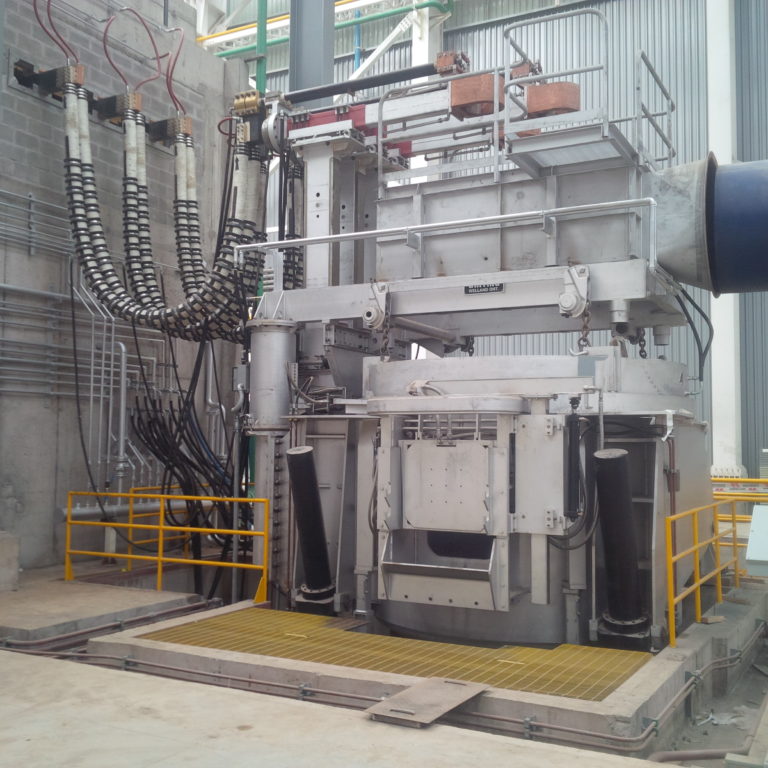
Electric Arc Furnaces (EAFs) sit at the heart of today’s steelmaking industry. They transform raw scrap and other feed materials into high-quality metals with speed, flexibility, and efficiency. Whiting Equipment Canada has spent more than 140 years engineering equipment that keeps melt shops like yours running stronger, safer, and longer. This article takes you through the essentials of EAF design and upgrade—covering power, control, and throughput—so you can see where the biggest gains in performance and ROI can come from.
What is an Electric Arc Furnace (EAF)?
At its core, an EAF is a furnace that uses an electric arc to melt charged material. Whiting has been building equipment for the primary metals industry since 1884—and designing EAFs since 1914. Today, our solutions cover everything from complete furnace systems to the ladles and charging buckets that keep them fed. Beyond steelmaking, EAFs also play an important role in mineral fusion for abrasives and refractory products.
EAF Configurations: AC vs DC
Every furnace needs a power supply, and the two options are Alternating Current (AC) or Direct Current (DC). Whiting provides solutions for both, with AC or DC drive systems that can be installed in winch-style or hydraulic mast designs.
On the transformer side, we distribute Norsk Trafo Service AS (NTS) equipment, available in both shell and core types. The shell-type design has a significant advantage—it offers just a fraction of the impedance of a core-type, which means maximum power transfer and steadier arcs. That’s why it’s the preferred choice in many installations.
Core Components: Transformer, Electrode Regulator, Roof/Sidewall, Off-Gas
The performance of any EAF depends on the strength of its main components:
- Transformer – NTS transformers are custom-engineered in Norway and built for reliability. They’re compact, efficient, and force-cooled, and offer wide voltage ranges. Whiting backs them up with repair and commissioning services.
- Electrode Regulator – Our Volta-SAF regulator delivers precise arc control, adapting to different charge materials while minimizing short-circuit disruptions. It’s available for both new systems and retrofits.
- Roof/Sidewall – Hydro-Arc® furnaces feature rugged, water-cooled roofs and sidewalls built from reinforced steel plate. They’re designed to withstand the most demanding melt shop environments.
- Off-Gas – Clean air and safety go hand in hand. Whiting supplies canopy and “Doghouse” style fume capture systems, plus motorized hoods for converters to capture emissions efficiently.
Sizing & Power: MVA, kWh/t, Power-On Time
Choosing the right size furnace is about more than capacity—it’s about power efficiency. Hydro-Arc® furnaces range from compact 900-lb units to giants holding over 337,100 lbs of molten metal. Expanded capacity shells can increase scrap volume by up to 40% on the same platform, helping reduce the number of charges per heat.
We’ve also shown how revamps can stretch performance. For example, a 90-ton spout-pour furnace was successfully upgraded to a 135-ton eccentric bottom tap (EBT) unit, while retaining its original 75,000 kVA transformer. Regulators like the Whiting digital system help achieve high power quickly and optimize “power-on time,” turning energy into melted steel as efficiently as possible.
Electrode Regulation & Automation
Precision matters. Stable arcs and consistent heats come down to how well electrodes are controlled. The Advanced control & regulators we provide enable the system to adjust quickly and adapt to changing charge conditions, delivering steady, reliable arcs as per the melt models tailor-made by Whiting.
Automation takes it a step further. With the Whiting Furnace Systems, operators gain a comprehensive furnace control system that integrates PLCs, SCADA, animated graphics, and real-time monitoring. It oversees charge weight, shell and roof temperature, tilt/pour control, and electrode positioning—all with built-in troubleshooting and reporting tools. The result? Less wasted power, more consistent heats, and a smoother operator experience.
Charging Strategies
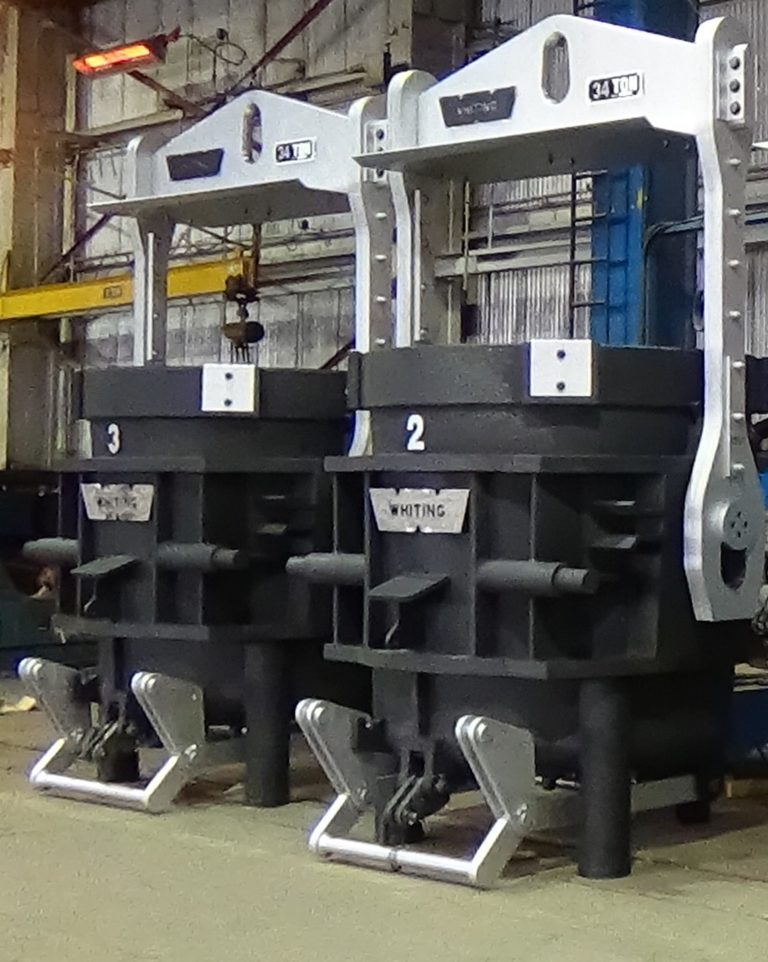
Charging may seem simple, but it’s one of the biggest levers for productivity. Whiting builds large charging buckets—such as our 3500 cubic-foot clamshell as well as orange peel and sivyer designs for smaller foundries—that make it possible to feed more material per heat. For AOD vessels, fully automated alloy addition systems can handle weighing and delivery with precision.
When paired with the Whiting Furnace System, charge weight and infeed controls, strategic charging can significantly reduce cycle times. In fact, reducing the number of charges per heat is possible, which reduces tap-to-tap time and saves a significant amount of energy.
Off-Gas, Slag Practice & Yield
Three factors heavily influence efficiency and profitability:
- Off-Gas – Off-gassing must be controlled due to environmental standards. Canopy, Fourth Hole, Side Draft, and Doghouse are systems that help keep fumes under control, while a motorized converter hood for AOD is used to capture fumes during the refining process.
- Slag Practice – Hydro-Arc® furnaces are built with deep sidewalls and dished bottoms to promote better slag-metal interaction and ensure complete drainage. Features like submerged tap holes and fast return cutoffs deliver cleaner pours.
- Yield – With more than 70% of North America’s AOD heavy equipment built by Whiting and processed by our partners, we know how to maximize metallic recovery. These systems produce cleaner steel, tighter carbon control, and rapid sulfur removal, thereby boosting both yield and quality.
Revamp Playbook: Bottlenecks, KPIs & ROI
Upgrades aren’t just about adding capacity—they’re about removing bottlenecks. Our team works closely with clients to evaluate equipment condition, control systems, and melt shop performance, then recommends where an upgrade can make the most impact.
A good example of this is the 90-ton furnace (mentioned earlier) that was transformed into a 135-ton EBT unit. Many original components were reused, but new tube-panel sidewalls, shell, and roof lift were added. The system was shipped preassembled, cutting downtime and construction costs.
The ROI is clear:
- More capacity with fewer charges per heat.
- Lower operating costs through reduced energy and electrode consumption.
- Flexibility for staged upgrades that spread out investment while capturing early gains.
Safety, Refractory & Maintenance
Safety, refractory life, and maintenance are the three pillars of reliable furnace operation.
- Safety – From automatic ladle brakes to slag pot transfer cars and ergonomic relining lifts, Whiting designs equipment that helps keep workers safe and operations efficient. Built-in interlocks and regulator safeguards enable protection against electrical and mechanical hazards.
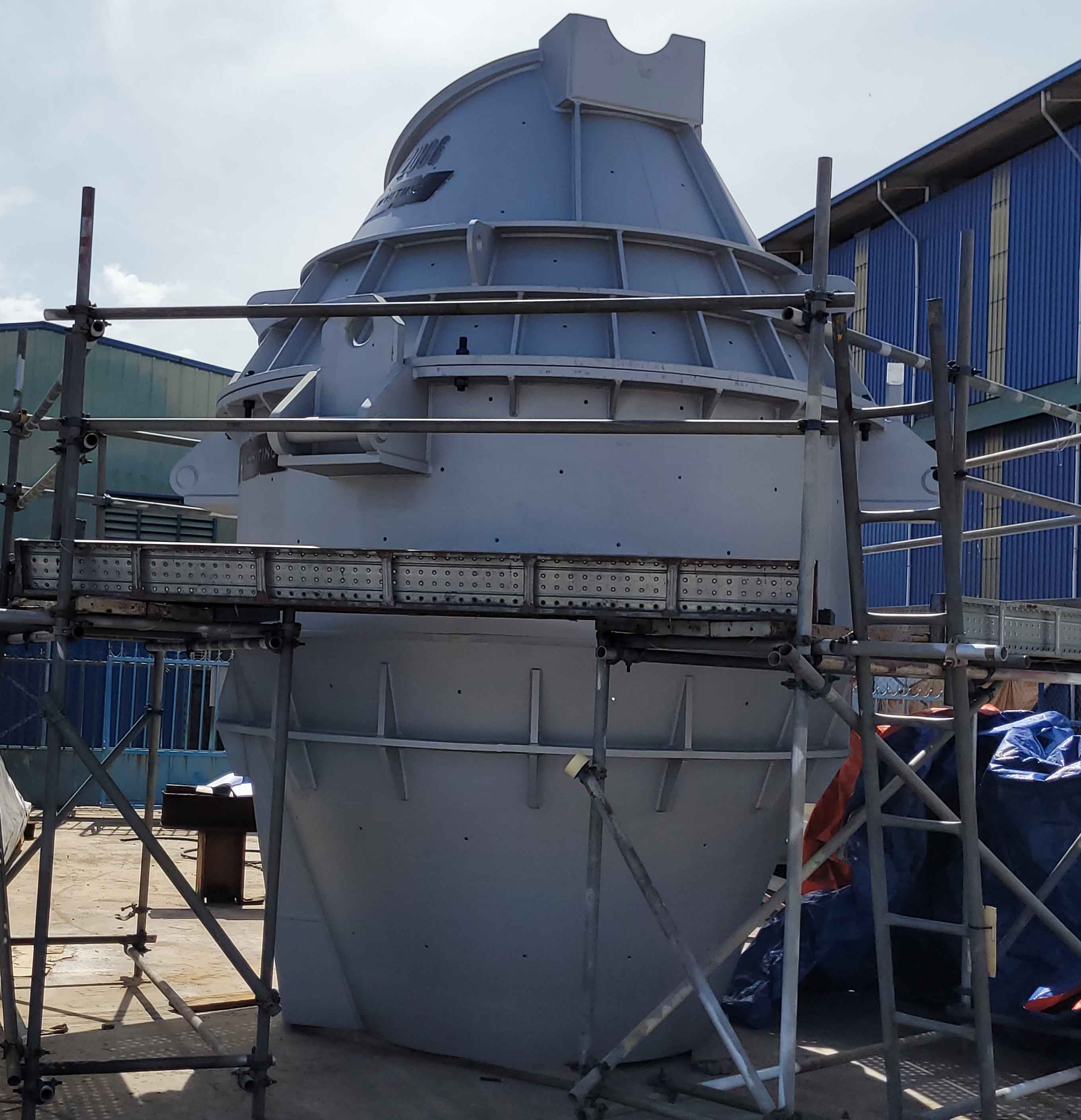
- Refractory – Hydro-Arc® designs extend refractory life with water-cooled roofs and sidewalls, while dish-shaped bottoms avoid hot spots. For AOD vessels, removable cones enable faster relining. The ergonomic lifts suggested by our team can improve bricklaying efficiency by 20%.
- Maintenance – Systems like the Whiting Furnace System simplify upkeep with troubleshooting screens and automated monitoring. Components, such as ladle gearing, are built with automatic lubrication to extend their service life. And when repair or commissioning is needed, our service team has the expertise to deliver.
Conclusion
Designing or upgrading an Electric Arc Furnace is about more than adding capacity—it’s about building a system that balances power, control, safety, and long-term efficiency. With over a century of proven experience, Whiting Equipment Canada provides the expertise, equipment, and services needed to optimize every part of your melt shop operation.
Ready to explore how an EAF upgrade can improve throughput, reduce costs, and strengthen your bottom line? Contact our team to start the conversation.
FAQs: Common Spec Questions
What is Whiting’s experience with EAFs?
We’ve been building equipment for over 140 years, and EAFs since 1914.
What solutions are offered?
Complete EAF systems, charging and handling equipment, transformers, and revamp services.
Does Whiting supply parts and services?
Yes—repair, commissioning, and metallurgical services are part of our offering.
How is durability ensured?
Every product is “Built to Perform. Designed to Last. Trusted Worldwide.”
What are the benefits of working with Whiting?
Proven expertise—demonstrated by the fact that Whiting has built more than 70% of North America’s operating AOD units and over 200 EAFs in its history.