
Defining Automation for the Heavy Industrial Sector
Ask what is industrial automation in a distribution center and you’ll get an answer about conveyors, pick-and-place arms, and sortation. Ask the same question on the floor of a melt shop and the answer changes entirely. Heavy industry deals in tonnage, radiant heat, slag, and equipment measured in decades of service life rather than product cycles.
The useful distinction is between fixed automation (a hard-tooled charging sequence that does one thing reliably forever) and flexible automation, where programmable controls let the same ladle transfer car or railcar mover handle varied loads and routes. Heavy duty industrial applications usually need both, layered.
What drives the investment case is the Five D’s:
- Dull — repetitive crane cycles and shuttle moves where operator attention degrades over a shift.
- Dirty — dust, scale, and fume environments that shorten human exposure limits.
- Dangerous — molten metal proximity, pinch points, and rail interfaces.
- Dear — tasks where scrap, downtime, or misplaced loads carry severe cost.
- Difficult — precision positioning at capacities no human operator can judge by eye.
Industrial Automation Control Systems (IACS) are what make those environments governable: the sensors, controllers, drives, and interlocks that keep sequences deterministic when ambient conditions are hostile.
Heavy industrial automation isn’t about speed, rather, it’s about predictable control of enormous forces.
The Architecture of Control: From Sensors to Cloud Integration
Modern industrial automation control systems are layered, and the Purdue Enterprise Reference Architecture (PERA) remains the clearest way to describe that stack. Each level has a distinct job, and each boundary is a place where data and risk cross.
| Level | Function | Typical Assets |
| 0 | Physical process | Encoders, load cells, thermocouples, limit switches, drives |
| 1 | Basic control | PLCs, safety controllers, motion controllers |
| 2 | Supervisory control | HMIs, SCADA, operator stations |
| 3 | Site operations | Historians, production scheduling, MES |
| 4 | Enterprise | ERP, maintenance planning, business analytics |
Levels 0 and 1 are the foundation of every heavy asset. A furnace charging car or coil transfer vehicle lives or dies on the quality of its position feedback and the logic in its PLC. Everything above is interpretation.
The shift underway is pushing Level 3 and 4 data into cloud platforms so that vibration trends, cycle counts, and fault histories inform maintenance planning rather than sitting in a local historian. That requires IT and OT to agree on protocols, uptime expectations, and change control which is a cultural negotiation as much as a technical one. Context helps: global operational stock of industrial robots reached approximately 4.28 million units in 2023, according to the International Federation of Robotics, and nearly all of that installed base now generates data someone wants upstream.
Retrofitting vs. Replacement: The ROI of Modernizing Legacy Assets
A 40-year-old ladle crane or railcar mover may have a structurally sound frame with decades of service left. The obsolescence is almost never in the iron, but in the relay logic, the unsupported drive, and the operator cab bolted into the hot zone. Replacing the asset discards capital that’s still performing.
Whiting Equipment Canada’s Upgrades, Rebuilds & Controls approach targets that gap directly, re-engineering the control layer on equipment that’s already proven itself in service.
| Legacy Issue | Retrofit Solution | ROI Outcome |
| Relay logic, no fault diagnostics | PLC conversion with event logging | Shorter mean time to repair |
| Obsolete drives, no spares | Modern VFDs and motion control | Reduced unplanned downtime |
| Manual in-cab operation | Remote or semi-automated control | Operator removed from hot zone |
| No condition data | Sensor instrumentation to historian | Planned rather than reactive maintenance |
The automation ROI in steel plants comes fastest from this path because the structural CAPEX is already sunk. The appetite is there: North American robot orders grew by 8% in Q4 2024 compared to Q4 2023, according to the Association for Advancing Automation.
The safety return is the one that doesn’t appear on a depreciation schedule: every retrofit that moves an operator out of a Dangerous or Dirty zone permanently reduces exposure.
Automation Technologies for Steel and Melt Shop Environments
Harsh-environment automation succeeds or fails on component selection. Sensors that perform flawlessly in a packaging line will drift, foul, or fail outright under radiant heat and conductive dust. The engineering work is as much about protection, cooling, and redundancy as it is about logic.
Steel and Melt Shops
Automated ladle handling is the clearest case. Sequenced lift, transfer, and tilt operations under closed-loop position control deliver repeatable pours while keeping personnel away from the pour stream. Rebricking ladles require ladle lifts as opposed to scaffolding to enhance safety and efficiency.
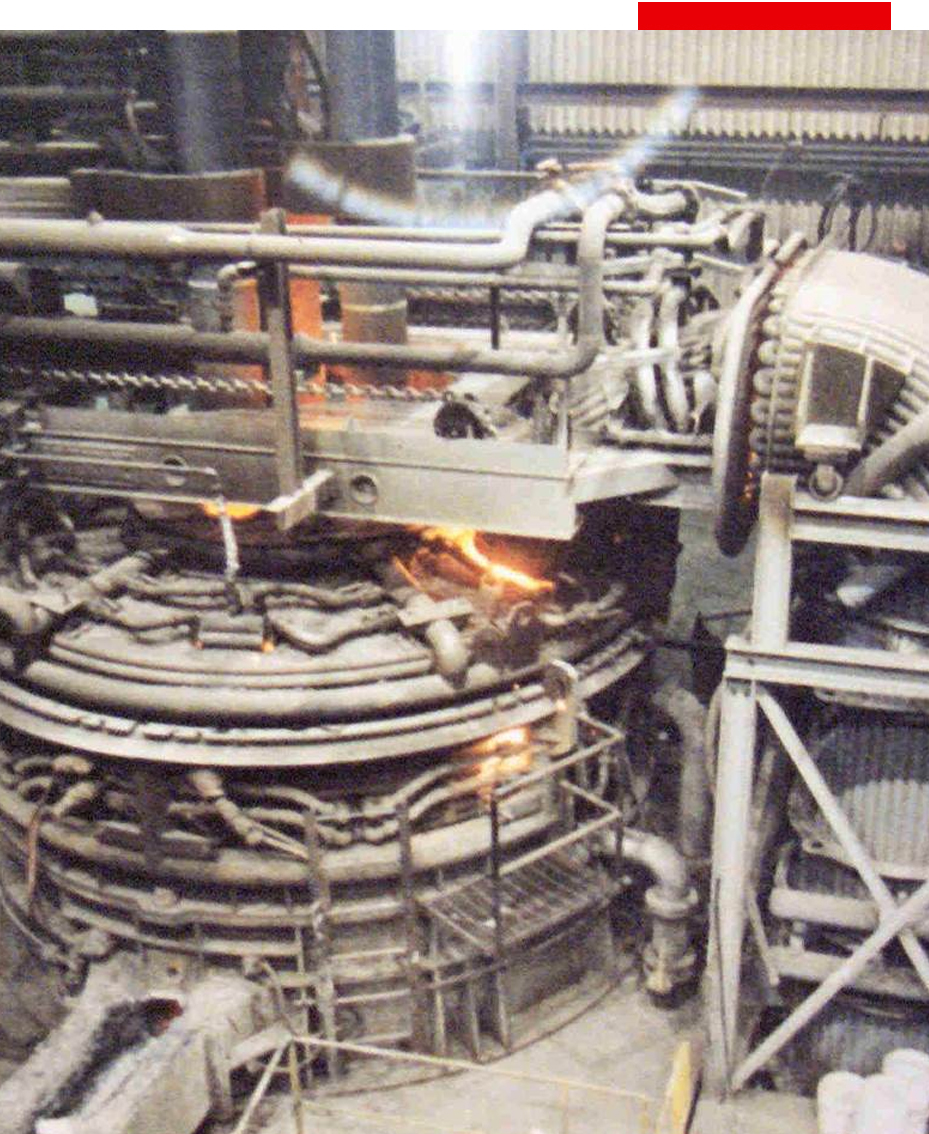
Furnace charging systems benefit similarly — bucket positioning, roof swing coordination, and charge timing become deterministic sequences with interlocks rather than judgment calls made through heat shimmer. Supporting rail movement, scrap handling, and slag pot transfer all fold into the same control architecture, which is what turns isolated machines into automated material handling systems.
Chemical and Custom Applications
Chemical plants bring different constraints: corrosive atmospheres, classified areas, and process sequences where a mispositioned load has consequences beyond scrap. Custom-integrated assembly and transfer equipment addresses these one application at a time. For advanced, custom-engineered automation in unique heavy-duty applications, Handling Specialty builds to the specific geometry and duty cycle rather than adapting a catalog machine.
Durability isn’t a feature in these environments, it’s the entry requirement.
Navigating the Risks of IT/OT Convergence
The most common objection to cloud-connected controls is that the plant network is air-gapped. It rarely is. Vendor laptops, remote support modems, USB drives for program updates, and wireless gateways on new drives all create paths that never appear on the network diagram. Treating an assumed air gap as a security control is how legacy PLCs end up exposed with no compensating protection whatsoever.
The alternative is deliberate segmentation. An Industrial Demilitarized Zone (IDMZ) sits between the control network and the enterprise network, brokering every data exchange so that no traffic passes directly from a business system to a controller. Historians, patch servers, and remote-access jump hosts live inside it. Production data flows up; commands do not flow down unchecked.
Three practices worth establishing before any upgrade begins:
Inventory every connected asset first. You cannot segment a network you haven’t mapped, and legacy controllers are routinely undocumented.
Stage the cutover. Run new controls in parallel or during planned outages so production continuity never depends on an untested configuration.
Define change control jointly. Operational Technology uptime requirements and IT patching cadences conflict by default; agree on the rules before the first conflict, not during it.
The Bottom Line: Key Takeaways for Industrial Leaders
For decision-makers weighing where to start, the strategic picture is fairly compact:
- Automation in heavy industry is primarily a safety and process-control mandate. Throughput gains follow from predictability, not from running equipment faster.
- Retrofitting legacy assets delivers ROI sooner than full replacement, because the structural capital is already in place and only the control layer is obsolete.
- The Five D’s — Dull, Dirty, Dangerous, Dear, Difficult — are the right screen for selecting a pilot project. Pick the task that scores on three or more.
- Level 0 and Level 1 infrastructure determines everything above it. Poor sensor placement and unreliable feedback will undermine any analytics platform built on top.
- IT/OT convergence requires architecture, not goodwill. Segmentation through an IDMZ, documented asset inventories, and agreed change-control procedures are prerequisites, not follow-up items.
The plants that get the most from automation are not the ones that bought the newest equipment — they’re the ones that made their existing equipment legible, controllable, and safe to operate at distance.
Partnering for Heavy-Duty Performance
Heavy industry doesn’t lend itself to off-the-shelf automation. Capacities, geometries, duty cycles, and ambient conditions vary enough from plant to plant that a standard product rarely fits without compromise, and in a melt shop, compromise shows up as downtime.
That’s the work Whiting Equipment Canada has built its practice around. In the company’s own words, their equipment is: “Built to Perform. Designed to Last. Trusted Worldwide, tackling unique or extreme requirements involving usage and large capacity.” Environments that punish ordinary equipment are the standing brief, not the exception.
For operations directors, the practical next step is an honest assessment of the existing fleet. Which assets are structurally sound but operating on obsolete controls? Which cycles still require an operator in a hot or dusty zone? Which machines produce no usable condition data at all? Those three questions usually identify the retrofit candidates with the strongest business case.
Whiting’s Upgrades, Rebuilds & Controls team can evaluate existing melt shop and rail equipment for modernization potential. For custom-engineered automation in specialized heavy-duty applications, Handling Specialty provides the advanced integration capability to match.