

Defining Material Handling in the Heavy Industry Context
Material handling equipment (MHE) in heavy industry refers to the engineered mechanical systems used to lift, position, transport, and store loads that exceed the capacity and duty tolerances of general-purpose warehouse gear which typically include structural assemblies, castings, coils, and finished units measured in tons rather than pounds.
The distinction matters because the failure modes differ. A distribution center moves standardized, palletized unit loads across flat concrete on predictable cycles. A locomotive shop, an aerospace assembly bay, or a steel melt shop moves irregular geometry at near-capacity, often repeatedly, often in heat, dust, or corrosive atmospheres. Industrial material handling equipment built for the first environment deforms, fatigues, or simply cannot reach into the second.
That capability gap carries real weight across the industrial base. Small and medium-sized manufacturers represent 98% of the U.S. manufacturing base, and scaling any of them depends on infrastructure that holds up under load. The consequences of getting it wrong show up in injury data: OSHA receives approximately 25 Severe Injury Reports per day across industrial sectors, and there were 2,426 work-related amputations reported to federal OSHA in 2024. Meanwhile, 54% of manufacturers plan to adopt robotics and automation in the next five years, layering new control demands onto systems that must already survive punishing service. Where catalog equipment stops, engineered solutions begin.
Primary Categories of Heavy-Duty Handling Systems
Heavy manufacturing handling divides into four functional groups, each with its own structural and control requirements. The technology inside them is changing quickly and 54% of manufacturers plan to adopt robotics and automation in the next five years, which will reshape how each category below is specified and integrated.
Positioning Equipment
Positioning systems hold or index a workpiece at a controlled location during fabrication or assembly. Precision and repeatability matter as much as capacity.
- Industrial material handling AGVs
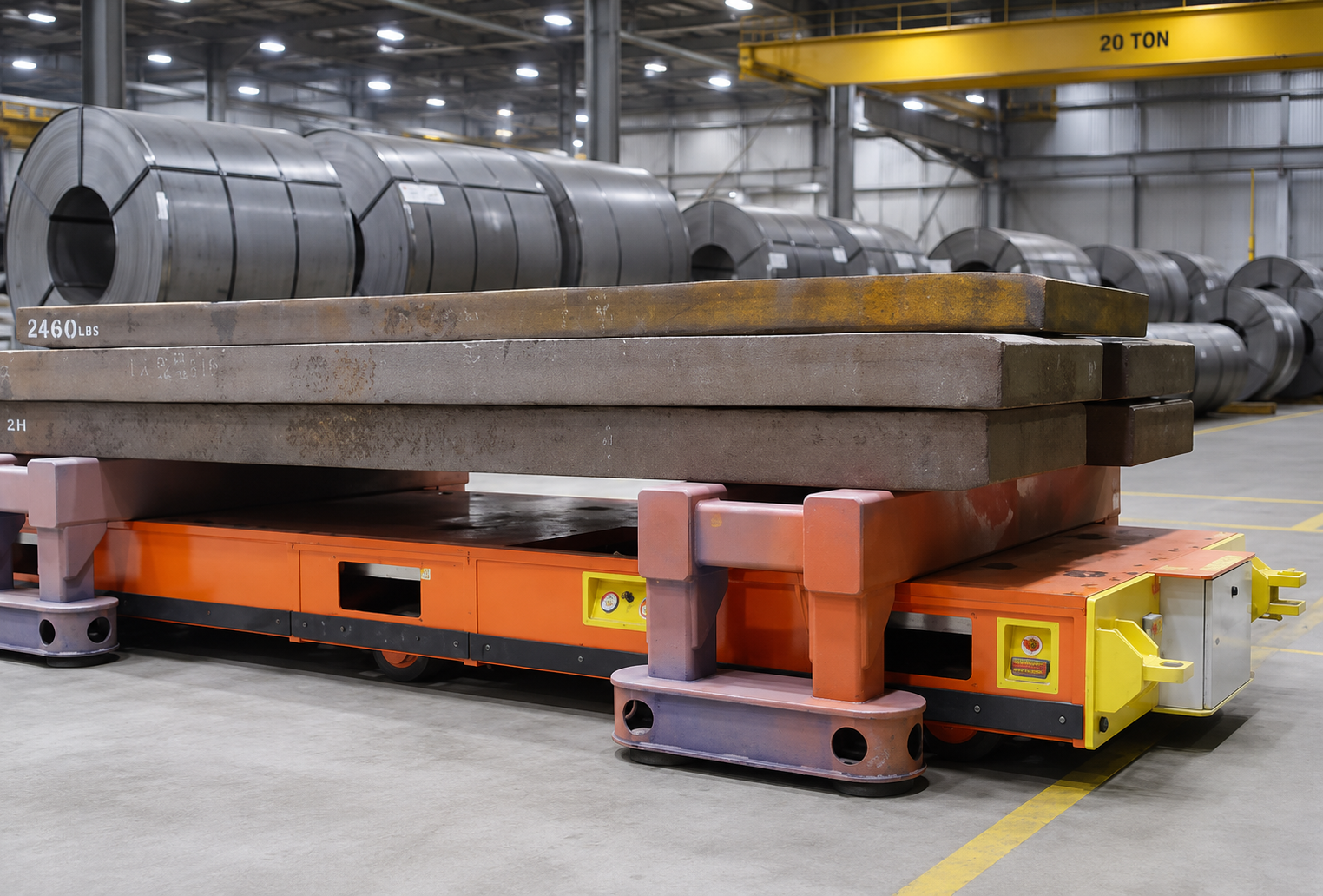
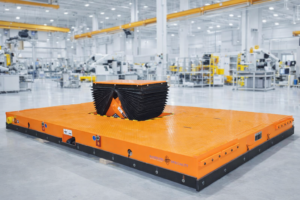
- Custom-built transfer cars and shop floor transfer tables
- Turntables, upenders, and welding positioners
Lifting Equipment
Lifting systems carry the full load path from the structure to the hook. Service class, not just rated tonnage, determines suitability.
- Severe-service overhead bridge and gantry cranes
- High-capacity wire rope and chain hoists
- Jib cranes and workstation lifting systems
Transport Equipment
Transport moves material between cells, buildings, or rail interchange points.
- Railcar movers and car pullers
- Heavy-duty AGVs and powered transfer vehicles
- Industrial trailers and coil transporters
Storage and Bulk Handling
Storage must support concentrated point loads from dense raw stock.
- Coil and roll cradles
- Casting and billet racking
- Bulk hoppers, chutes, and feeders
The Critical Role of Duty Cycles and Service Classes
Rated capacity answers only half the specification question. The other half is how often, how far, and how close to that rating the machine will work. Two 50-ton cranes with identical nameplates can have wildly different structural lives if one lifts twice a shift and the other cycles continuously near capacity.
CMAA service classes for cranes and HMI duty ratings for hoists exist to capture this. They describe the expected distribution of load magnitude and cycle frequency over the equipment’s life, which drives girder sizing, wheel selection, motor thermal rating, and brake duty.
| Service Class | Typical Application |
| Class A–B | Maintenance bays, powerhouses, infrequent lifts |
| Class C | General machine shops, moderate assembly |
| Class D | Heavy machine shops, foundries, fabricating |
| Class E | Continuous handling of near-rated loads |
| Class F | Steel mill, continuous severe service |
The engineering consequence sits in fatigue. Structural members accumulate damage from stress cycles, and lifting near capacity consumes that fatigue life far faster than occasional light lifts. Operations running continuous, near-rated cycles in hot or abrasive conditions routinely exceed what standard product lines are designed to absorb, which is where custom material handling equipment, sized to an actual measured duty profile rather than a catalog assumption, becomes the only defensible specification.
Safety and Risk Mitigation in High-Capacity Environments
Energy stored in a suspended multi-ton load has no tolerance for a sloppy design margin. When heavy-duty material handling systems fail, the outcomes are rarely minor, and the industrial injury record reflects how often serious events occur across manufacturing floors.
OSHA receives approximately 25 Severe Injury Reports per day across industrial sectors.
There were 2,426 work-related amputations reported to federal OSHA in 2024.
Amputation risk clusters around pinch points, unguarded drives, and manual intervention in load paths. Engineered guarding, interlocks, and automated positioning remove the operator from those zones rather than relying on procedure alone.
Treating OSHA compliance as the design target sets the bar too low. Regulatory minimums are written for general applicability; a severe-service crane over a molten metal pour or a transfer car carrying an aerospace fuselage section needs margins well beyond them. That means redundant braking, load-limiting controls, anti-two-block protection, and failsafe holding on custom trolleys and below-the-hook lifting beams — mechanisms that default to a safe state when power, hydraulics, or a single component is lost. Safety-by-design means the equipment protects the operator when something breaks, not only when everything works.
Specialized Handling: Below-the-Hook and Hazardous Zones
Attachments
The hook is an interface, not a solution. Load geometry determines what belongs below it, and a mismatched attachment transfers stress into places the workpiece was never designed to carry it.
- Spreader and lifting beams to control sling angle and compressive load
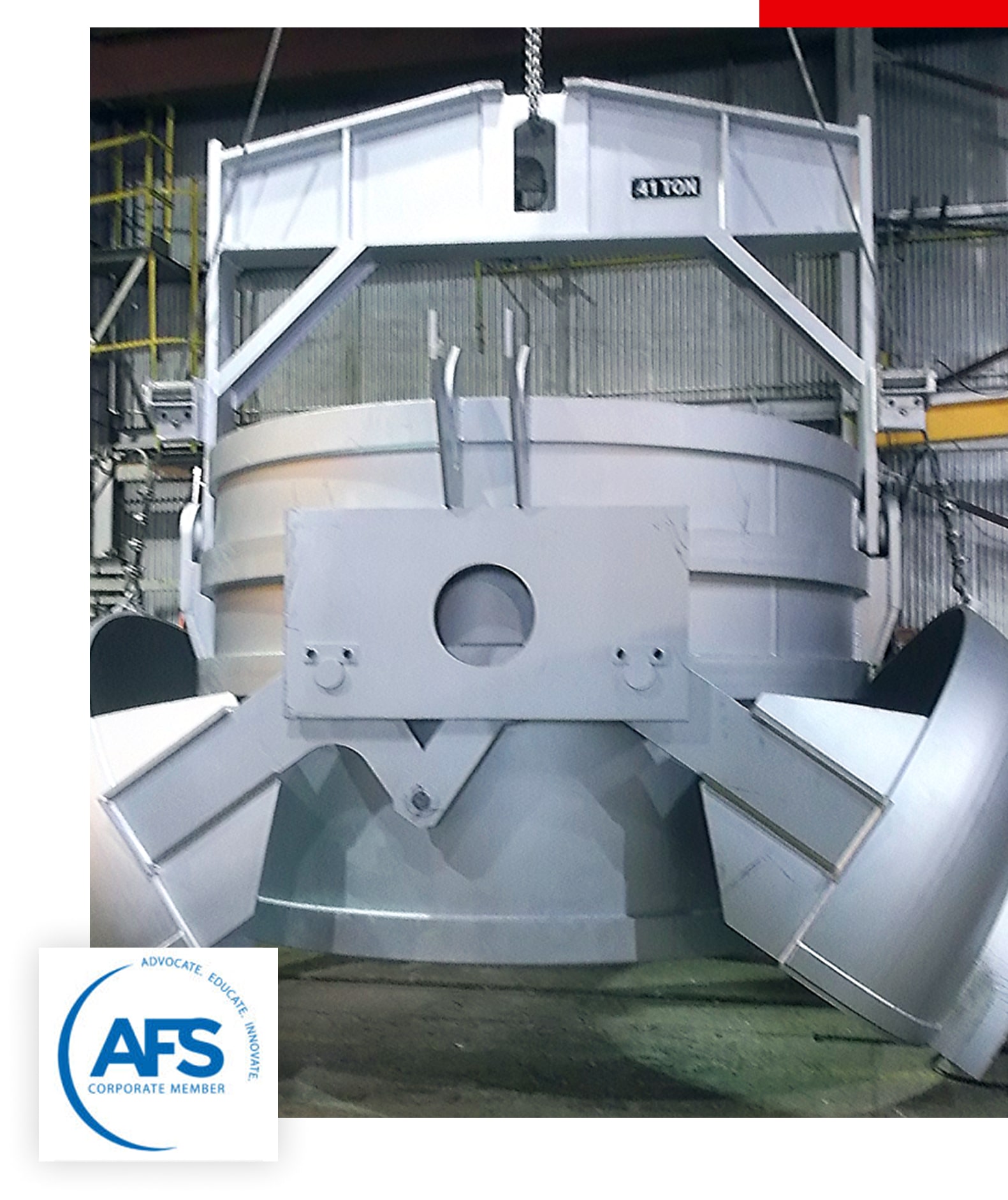
- C-hooks and coil grabs for wound stock and through-eye lifts
- Lifting magnets and vacuum lifters for flat plate and sheet
- Tongs, grapples, and custom fixtures matched to part contour
Hazardous Zones
Combustible dust, flammable vapors, and ignitable fibers change the electrical specification entirely. Classification governs every motor, control, brake, and festoon on the machine.
- NEC Class I, II, and III designations by hazard type
- Division 1 and Division 2 ratings by likelihood of exposure
- Explosion-proof enclosures, spark-resistant materials, and bonded grounding paths
Environmental Protection
Harsh operating environments degrade equipment faster than load does.
- Thermal shielding and heat-resistant cabling near furnaces and pours
- Sealed bearings, filtered enclosures, and positive-pressure cabinets in dust
- Corrosion-resistant coatings and hardware for chemical or marine exposure
Correct attachment selection also protects the product: controlled contact points prevent distortion, surface damage, and the load shift that precedes a dropped lift.
Key Takeaways for Industrial Material Handling
The specification logic for heavy manufacturing differs fundamentally from warehouse procurement. These points summarize what drives a defensible equipment decision.
- Heavy-duty material handling equipment must be specified by duty cycle and service class, not by rated tonnage alone — two machines with identical capacity ratings can have very different structural lives under continuous near-capacity use.
- Custom engineering becomes necessary when the application involves extreme capacities, non-standard geometry, continuous severe service, or hazardous atmospheres that standard product lines were never designed to survive.
- Safety performance depends on matching equipment to the specific load geometry and operating environment; below-the-hook attachments, guarding, and failsafe mechanisms should remove operators from load paths rather than depend on procedural controls.
- Automation and robotics are moving from pilot projects to standard practice in high-capacity throughput environments, which means control integration should be considered at the initial design stage rather than retrofitted later.
- Long-term reliability rests on proactive inspection and maintenance programs aligned to ASME and OSHA standards, with intervals set by actual duty profile rather than generic schedules.
- Treat regulatory compliance as the floor. Equipment handling molten metal, pressurized assemblies, or multi-ton structural sections warrants design margins well above the regulatory minimum.
Solving Complex Handling Challenges with Whiting Equipment Canada
Whiting’s focus shapes the approach: applications that fall outside standard catalogs, one-of-a-kind lifts, unusual spans, extreme duty cycles, & hazardous classifications get engineered from the application requirements up, not adapted from a nearest-match product.
The product range reflects the breadth of heavy industry itself, from railcar movers and transfer cars to severe-service cranes and custom trolleys engineered for specific rail profiles and load paths. Among material handling equipment manufacturers, the differentiator is engineering capability applied before fabrication begins.
What makes equipment “severe service”? Continuous or near-continuous operation at or near rated capacity, often combined with heat, dust, or corrosive exposure. It requires heavier structural sections, higher-rated components, and shorter inspection intervals.
When does a custom MHE solution make more sense than a standard crane? When span, capacity, headroom, environmental classification, or load geometry falls outside what standard product lines cover, or when integrating with existing building structure or automation.
How is MHE capacity determined for a custom lifting system? From the actual load profile, including dynamic factors, attachment weight, and the expected distribution of lift cycles over the equipment’s service life.
Can existing MHE equipment be upgraded instead of replaced? Often yes, through structural assessment, control modernization, or component upgrades, depending on remaining fatigue life.